
Precision Pool Water Testing For Safe & Crystal-Clear Results
For Precision-Minded Pool Owners, Guessing Isn’t Good Enough If you’re the kind of pool owner who prefers data over assumptions and consistency over...
⬢ Pool Professionals
Professional-grade products. Expert support. Built for your business.
⬢ Pool Owners
Eco-friendly, easy-to-use solutions to keep your pool clean and clear.
⬢ Industrial
Efficient treatment & supply. Performance-focused operations support.
⬢ Municipal
Reliable solutions & delivery. Sustainable treatment for public systems.
⬢ Dealers
Help your pool & spa customers with trusted, professional-grade products.
⬢ Pool Products
HASA has the chlorine, algaecides, and sanitizers you need to keep your pool or spa clean and clear.
⬢ Hot Tub Products
Shop our full line of Hi-Temp spa care products, including Eco-Safe Clarifiers and pH Increasers.
⬢ Ancillary Products
Our eco-friendly water treatments are science-backed and purposefully focused.
⬢ Mini-Bulk Program
We deliver a premium 12.5% sodium hypochlorite solution for sanitizing commercial pools and large-scale water systems.
⬢ Blog
Learn from water chemistry experts.
⬢ Videos
Browse instructional how-to videos.
⬢ Safety Data Sheets
Download SDS sheets for HASA products.
⬢ Pool Chemical Calculator
Achieve balanced chemistry easily.
⬢ Liquid Chlorine For Pools
A service professional’s guide that's been made simple.
⬢ Orenda Academy
For water chemistry & professional pool management knowledge.
⬢ Events
Find HASA at an event near you.
⬢ Rewards
Explore our HASA loyalty rewards program.
⬢ About HASA
Learn about HASA's commitment via the returnable packaging model.
⬢ Careers
Explore open positions with HASA.
When you walk past a pool and catch that strong “chlorine smell,” your first thought might be that there’s too much chlorine in the water. But here’s the twist: that smell actually means there’s not enough active chlorine doing its job. What you’re sensing are chloramines—the byproducts that form when pool chlorine reacts with sweat, oils, or other contaminants.
In pool terms, this is known as combined available chlorine (CAC), and it’s the real culprit behind red eyes, dry skin, and that telltale odor.
Much like a detective investigating a crime scene, understanding your pool’s chemistry starts with gathering evidence. By testing, identifying, and correcting CAC, you can restore clean, balanced water and make your pool a healthier place to swim. Consider this your guide to cracking the case of pool chemistry and mastering the science behind crystal-clear water.
Keeping your pool safe and clear starts with understanding what’s really happening in the water. Think of this as the “forensics phase” of your investigation, when you collect clues, test your theory, and identify what’s throwing your pool chemistry off balance.
Pool chlorine is your primary defense against bacteria, algae, and organic contaminants. When added to water, it forms free chlorine, the active sanitizer that kills germs and oxidizes waste. Over time, though, that free chlorine binds with contaminants like sweat, sunscreen, and body oils. Once that happens, it becomes combined available chlorine, which is much less effective at sanitizing.
In short, the types of chlorine include:
When CAC builds up, your pool starts to show signs of distress: cloudy water, harsh odors, and eye irritation. The chemistry has gone from protective to problematic.
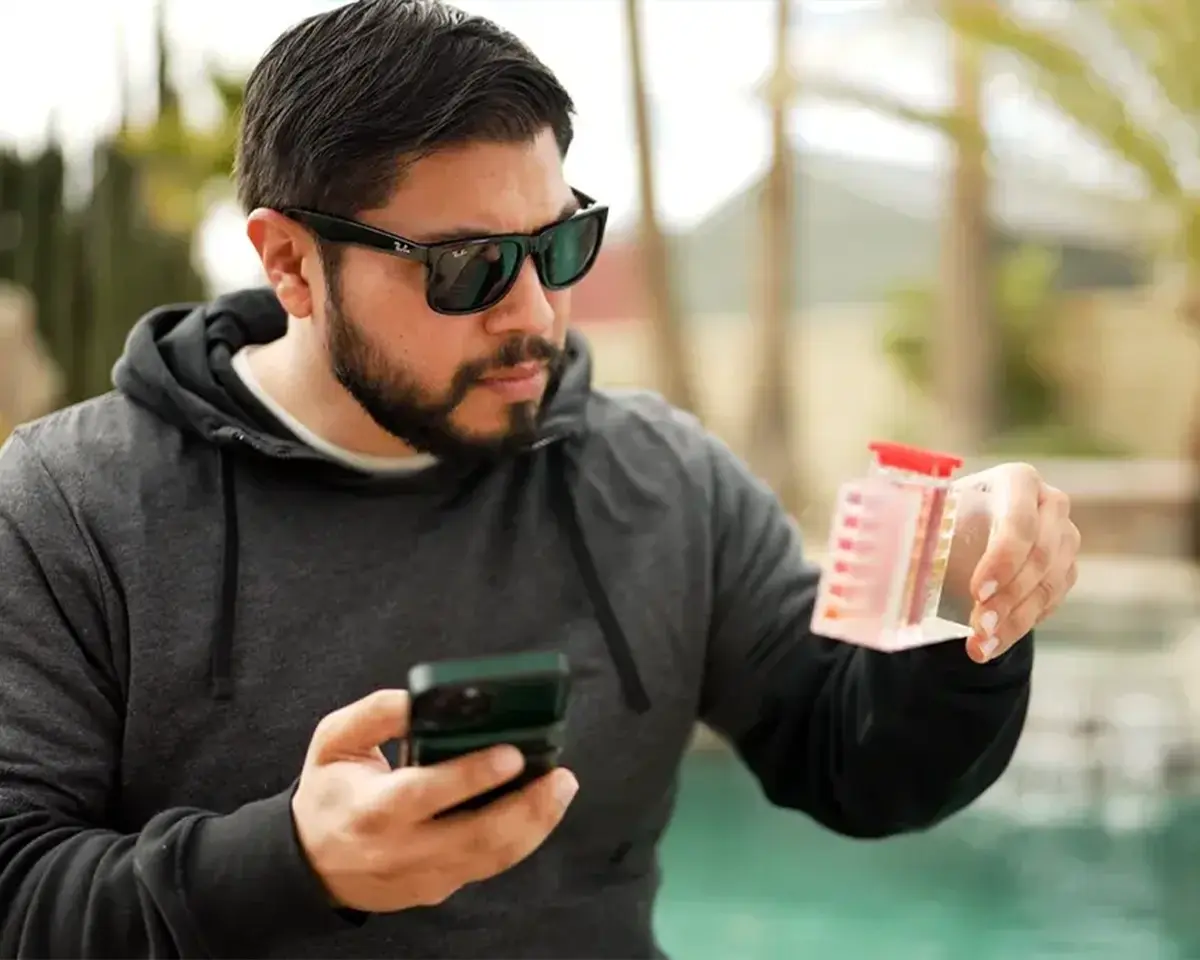
To keep your pool chlorine working efficiently, regular testing is non-negotiable. Use a pool testing kit or a digital photometer that measures both free chlorine and total chlorine levels. The difference between the two tells you how much combined available chlorine is present:
Total Chlorine (TC) – Free Chlorine (FC) = Combined Available Chlorine (CAC)
For example, if your test shows:
That 0.5 ppm might seem small, but it’s a sign chloramines are forming—and it’s time to take action. Ideally, your CAC should remain below 0.2 ppm for healthy, clear water.
Mobile apps like the LSI/Orenda app, smart pool systems, or test kits make tracking your water balance easy. These tools record test results, help calculate chemical adjustments, and flag early warning signs before CAC becomes a full-blown problem.
Testing should become part of your routine. A consistent schedule helps maintain a perfect balance between sanitizer strength and swimmer comfort, ensuring your water treatment chemicals do their job efficiently for a healthy swim.
Every crime has a culprit—and in the world of pool chemistry, chloramines are the repeat offenders. These irritating compounds form when pool chlorine reacts with nitrogen-based contaminants like sweat, urine, or sunscreen. The result is combined available chlorine—a signal that your sanitizer has been compromised.
Just as detectives identify suspects by their fingerprints, pool owners can spot different chloramines by their effects on the water and swimmers.
There are three main types of chloramines, each leaving distinct clues behind:
Trichloramine is the biggest giveaway that your chlorine is working overtime but losing the fight. Contrary to popular belief, that strong chlorine odor means there’s too little free chlorine, not too much.
Chloramines thrive on organic material and poor maintenance practices. Here are the most common causes:
Every one of these factors reduces your chlorine’s effectiveness. They shift the balance from free chlorine to combined available chlorine, the chemical equivalent of fingerprints at the crime scene.
Why identifying CAC matters
Understanding which chloramine you’re dealing with helps determine the right response. A mild odor might only require a small shock treatment, while persistent irritation and haze point to severe contamination that needs deeper intervention.
In short, identifying CAC is your key to restoring healthy pool chemistry. Once you’ve identified the suspect, it’s time to take action and reclaim your pool water.
Now that you’ve identified the suspects, it’s time to clean up the scene. The good news? Eliminating CAC isn’t complicated once you understand what it takes to break chloramines apart. The key is restoring balance with the right chlorine levels and supporting systems that keep your pool chemistry in check.
The most effective way to remove chloramines is through shock treatment, also known as superchlorination. This process involves temporarily raising your chlorine level high enough to “breakpoint." This is the point where free chlorine molecules overpower and destroy chloramines.
In practical terms, you’ll typically need to raise your free chlorine level to at least 10 times the CAC reading. For example, if your CAC is 0.4 ppm, aim for around 4 ppm of free chlorine. Use high-quality water treatment chemicals to ensure full oxidation, and always test again afterward to confirm that your CAC has dropped below 0.2 ppm.
Timing matters, too. Shock at dusk or in the evening so sunlight doesn’t burn off chlorine before it does its job. And keep your pool circulation system running throughout the process to help distribute the sanitizer evenly.
Sometimes even a strong shock isn’t enough, especially in indoor pools where chloramines tend to linger in the air. That’s where secondary pool sanitization systems come in.
Think of these as your high-tech forensics lab—working alongside pool chlorine to eliminate persistent CAC and keep your air and water fresh.
Proper ventilation is equally important, especially indoors. Chloramines tend to hover just above the water surface, irritating swimmers’ eyes and lungs. Consistent airflow helps move those gases out and maintain a comfortable, odor-free environment.
Once the case is closed, prevention becomes your best defense. Regular habits can stop CAC from forming in the first place:
Once you’ve eliminated combined available chlorine, the next step is to make sure it doesn’t return. Like any good detective, prevention is your best strategy—staying ahead of problems rather than reacting to them. Consistent testing, balanced water chemistry, and smart use of pool chemicals will keep your pool clear, clean, and inviting all season long.
Weekly water testing routine
Testing shouldn’t be a once-in-a-while activity—it’s the cornerstone of pool maintenance. Aim to test your free chlorine (FC), total chlorine (TC), pH, and alkalinity levels at least twice a week, and more often during heavy use or hot weather.
Here’s a simple cadence to follow:
Consistent testing ensures your pool chlorine remains active and effective—protecting swimmers from bacteria while keeping CAC levels below 0.2 ppm.
Think of your water treatment chemicals as a team—each plays a specific role in maintaining balance.
Keeping these levels in range prevents chlorine inefficiency and stops CAC from reforming. When any one parameter drifts too far, your pool chemistry becomes unstable, opening the door to cloudy water, scaling, and odor.
Every great investigation ends with a clear conclusion. In this one, combined available chlorine is the culprit behind most of the problems pool owners mistake for “too much chlorine.” From red eyes and itchy skin to cloudy water and that sharp odor, CAC is the evidence your swimming pool chemistry needs attention.
By testing regularly, reducing your combined chlorine level, and using the right water treatment chemicals, you can prevent chloramines from taking over. Keeping CAC below 0.2 ppm ensures that your sanitizer is doing its job effectively, leaving your water clear, comfortable, and safe.
Think of your pool as a living system that constantly changes with use, temperature, and weather. Like a good detective, you’ll get the best results by staying observant, following the evidence, and acting before small imbalances turn into big problems.
So next time you smell “chlorine,” don’t assume your pool has too much. Instead, take it as a clue that combined available chlorine is at work—and that it’s time for you to reopen the case, test the water, and restore balance. With the right know-how and consistency, you’ll keep your pool sparkling and your “crime scene” spotless all season long.
Learn more about water chemistry, testing, and regular maintenance with HASA. Try our Pool Chemical Calculator and achieve perfectly balanced water today.
For Precision-Minded Pool Owners, Guessing Isn’t Good Enough If you’re the kind of pool owner who prefers data over assumptions and consistency over...
In today’s recreational water industry, there are three main types of chlorine used to disinfect, oxidize and leave protective residuals in...
HASA is a big provider of liquid chlorine in my region and the familiar yellow cases and white bottles are available at local pool stores as...