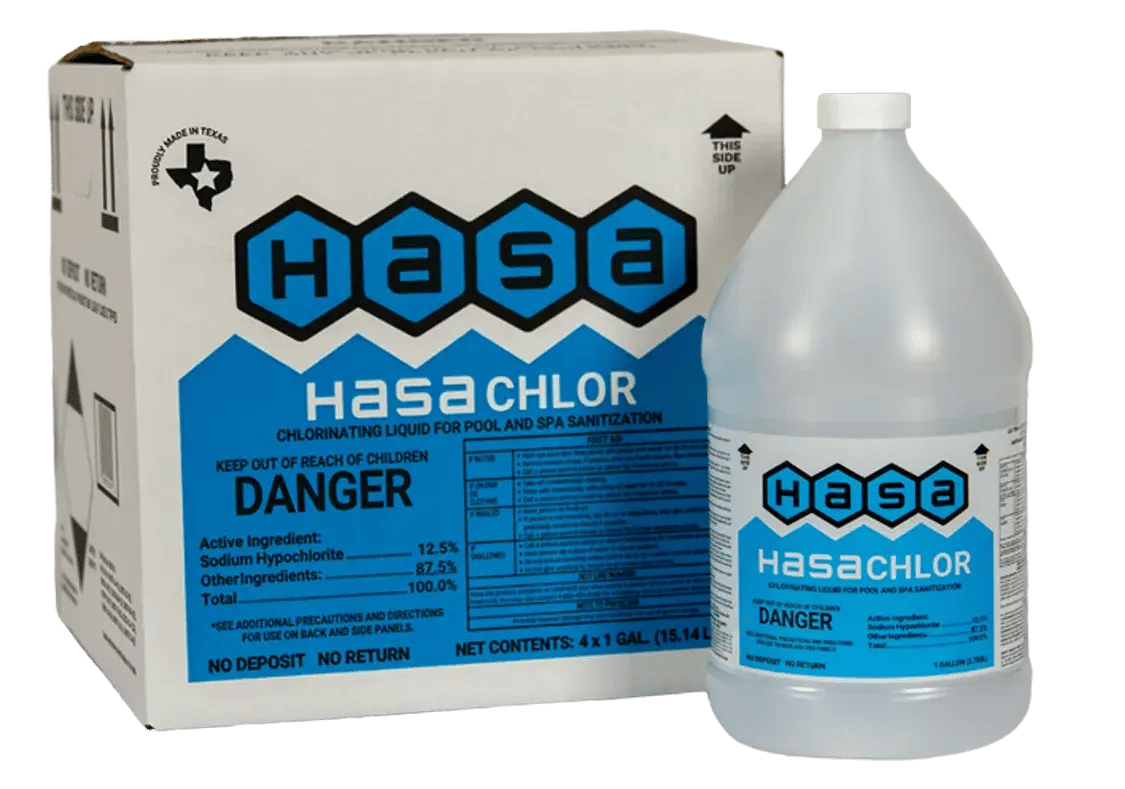

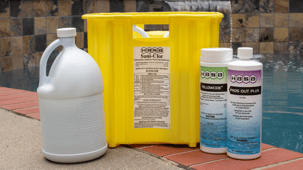
HASA CHLOR
Chlorinating Liquid For Pool And Spa Sanitation
Available Sizes
- 2x1 Gallons (Disposable Case)
- 4x1 Gallons (Disposable Case)
HASA CHLOR: High-Strength Liquid Chlorine for Pools and Spas
HASA CHLOR is a professional-grade, 12.5% sodium hypochlorite solution designed for the immediate sanitization of swimming pools and hot tubs. It provides a fast-acting, residue-free way to destroy algae, bacteria, and viruses without the cloudiness associated with granular shock.
What is HASA CHLOR used for?
HASA CHLOR is used to sanitize and shock swimming pools and hot tub water. Its liquid formulation mixes instantly with water to rapidly raise free available chlorine levels, making it ideal for both daily chlorination and super-chlorination (shocking) to clear cloudy water or eliminate algae blooms.
Why Choose HASA CHLOR?
For homeowners and pool professionals alike, HASA CHLOR offers a powerful alternative to standard bleach or slow-dissolving tablets.
- Commercial Strength: At 12.5% concentration, it is significantly stronger than household bleach, meaning you use less product to achieve crystal-clear water in less time.
- Instant Sanitization: As a liquid, it requires no dissolving time. It starts working immediately to kill contaminants.
- No Added Cyanuric Acid (CYA) buildup: Unlike trichlor tabs, HASA CHLOR does not add stabilizer to your water, preventing chlorine lock and reducing the need to drain and refill your pool.
- Safe for All Surfaces: Whether you have plaster, vinyl, or fiberglass, this liquid chlorine is safe for all pool finishes and compatible with salt, UV, and ozone systems.
Key Features & Benefits:
- Pure, concentrated sanitizer: Easily maintains a safe level of free chlorine to keep water sanitized and ready to use.
- Fast-Acting Shock: Instantly mixes to destroy organics and disinfect pool or spa water, with no dissolving time required.
- Unparalleled Compatibility: Works seamlessly with saltwater, UV, and ozone systems.
- Convenient Sizes: Available in disposable cases (2x1 Gallon and 4x1 Gallon) for easy transport and storage.
Dosing Instructions: How much liquid chlorine do I add?
To raise the chlorine level by 1 ppm (part per million) in a 10,000-gallon pool, add 10 fluid ounces of HASA CHLOR.
Always test your water before adding chemicals. For heavy algae or super-chlorination, higher dosages may be required.
Frequently Asked Questions
-
Is liquid chlorine better than tablets for pools?
Liquid chlorine is often considered better because it does not contain cyanuric acid (stabilizer). Many tablet products include stabilizers in their formulations, which can accumulate over time and affect chlorine performance. Using liquid chlorine allows for more direct and precise control of sanitation levels, offering flexibility without contributing additional stabilizer.
-
Can I use HASA CHLOR as a spa shock for hot tubs?
Yes, HASA CHLOR is an excellent spa shock for hot tubs. Because it is a liquid, it disperses instantly, leaving no grit on the spa floor and rapidly sanitizing the water after heavy use.
-
How does HASA CHLOR differ from grocery store bleach?
HASA CHLOR is formulated at 12.5% sodium hypochlorite, whereas standard grocery store bleach is typically only 3-6%. You would need to use 2-4 times as much household bleach to achieve the same level of sanitation that HASA CHLOR provides.
-
Does liquid chlorine raise pH?
Liquid chlorine has a high pH (around 13), so it will slightly raise the pH of your pool water upon addition. However, because it is neutral when oxidized and broken down, the net effect on pH over time is minimal compared to other shock types.
-
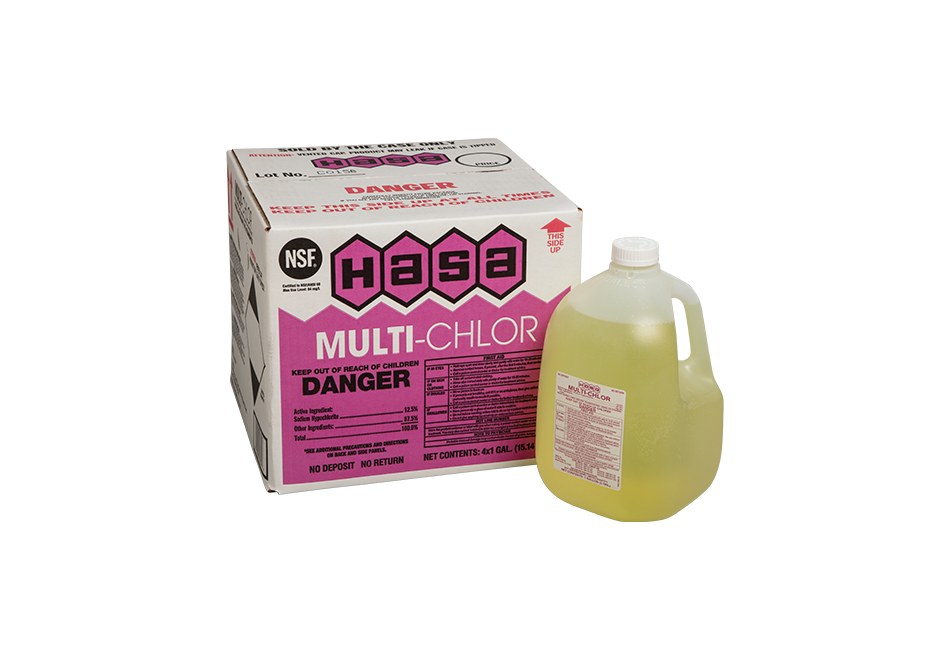
What’s the difference between HASA Chlor and HASA Multi-Chlor?
HASA Chlor and HASA Multi-Chlor offer virtually the same chlorine strength, so the primary differences come down to packaging and application. HASA Multi-Chlor is NSF-60 certified, making it suitable for potable (drinking) water use. HASA Chlor, typically used for pool and spa applications, is available in a convenient disposable packaging and is best for applications that do not require NSF-60 certification. The best choice depends on the intended use and packaging preference rather than strength or performance.
Related Products