Measuring and Dosing Accuracy: The Secret to Slashing Pool Chemical Costs
If we were completely transparent, pool chemicals aren’t getting cheaper. As the market evolves and baseline operational costs climb, pool service...

Pool Products
HASA has the chlorine, algaecides, and sanitizers you need to keep your pool or spa clean and clear.
Hot Tub Products
Shop our full line of Hi-Temp spa care products, including Eco-Safe Clarifiers and pH Increasers.
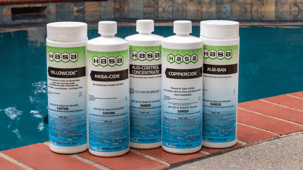
Performance Products
Our eco-friendly water treatments are science-backed and purposefully focused.
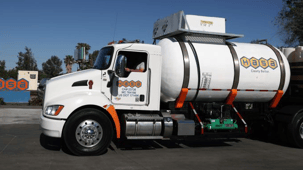
Mini-Bulk Program
We deliver a premium 12.5% sodium hypochlorite solution for sanitizing commercial pools and large-scale water systems.
7 min read
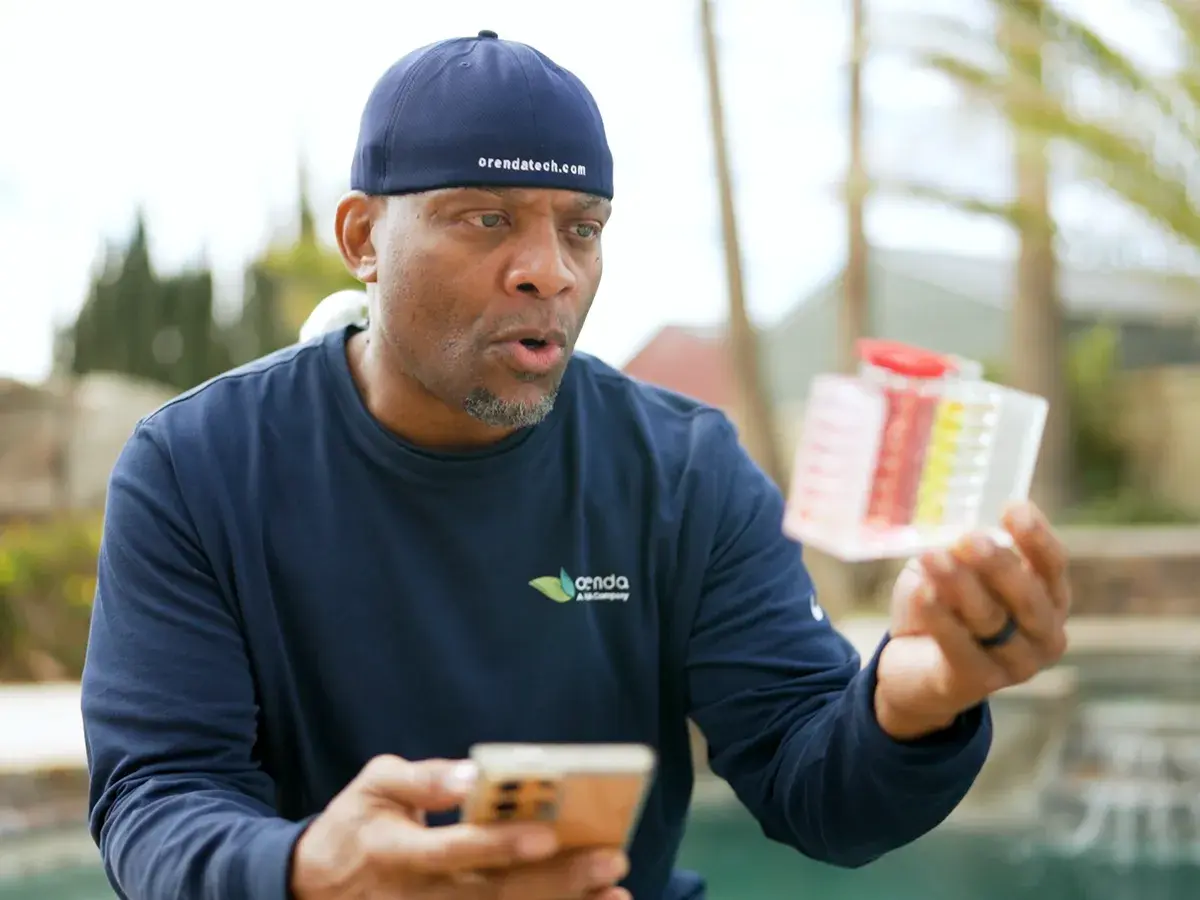
Water treatment in swimming pools means adjusting and maintaining water chemistry so the water stays safe, balanced, and usable, and pH control is one of the most important parts of pool water treatment. For pool service professionals, pool owners, and anyone responsible for pool care, understanding pH helps prevent corrosion, scale formation, and weak disinfection before those problems damage surfaces, pool equipment, or water quality. Proper water treatment ensures safe, balanced and enjoyable swimming pool water — the goal, throughout, is simple: treat water and regularly test to keep pH within range.
This guide explains what pH means, how it is measured, the recommended pool pH range, which chemicals lower pH, how to add acid safely, how to store pool acids correctly, and how pH fits into overall pool water balance and treatment processes.
The power of hydrogen is what the term pH means. When a pH test of swimming pool water is being conducted, it is to determine the presence of or lack of hydrogen. The pH is a measurement used to determine if water is acidic or basic. Lemon juice, vinegar and soft drinks taste sour because they contain a lot of hydrogen. They are acids. Baking soda, seawater, and antacids taste salty or chalky because they are bases or alkaline and they contain a high amount of hydroxyl ions and very little hydrogen, and in pools, chemicals like soda ash used to raise pH provide similar alkalinity adjustments as part of the overall treatment of water chemistry. Hydrogen represents acid and hydroxyl ions represent base. The more hydrogen ions present in the water, the lower the pH (acidic). The more hydroxyl ions present, the higher the pH will be (base). pH is a measure of the relative degree of acid or base in the water.
pH is measured using a scale that goes from 0 to 14 with 7 as neutral. Values below 7 are considered acidic, and values above 7 are basic or alkaline. The minimum recommended range is 7.2, and the maximum recommended range for pH is 7.8. The most acceptable pool pH is between 7.4 and 7.6. In swimming pools pH needs to be tested at least weekly to ensure it is within the acceptable range, as part of broader pool care tips for clear, healthy water.
The pH scale is logarithmic with every move up or down the scale being exponential. Every move up or down the pH scale represents a multiplier of 10. So, a pH of 6 is ten times more acidic than a pH of 7 and a pH of 8 is ten times more basic. A pH of 5 is one hundred times more acidic than pH of 7 and a pH of 9 is one hundred times more basic. It is important to note that adjustments made to the pH have large consequences.
pH tends to climb in most pools rather than drop. Aeration — from waterfalls, spillways, spa jets, or heavy splashing — causes CO2 to off-gas, and as CO2 leaves, pH rises. Fresh water fill-ups can raise alkalinity when fill water carries higher alkalinity than the pool. Certain sanitizers push pH up too: liquid chlorine and cal hypo carry excess sodium and calcium hydroxide that temporarily raises pH, and salt chlorine generators raise pH as hydrogen gas bubbles off in the salt cell. Carbonate alkalinity acts as the water's buffering system and sets a natural ceiling on how high pH can drift. In cases where too much acid has been added and pH has gone below the minimum range aeration can be used to bring the pH back into line without raising the total alkalinity.
pH plays an important role in the overall balance of pool water, especially the Langelier Saturation Index (LSI) in pool water. When adjusting for a balanced LSI, always consider the pH first. This will ensure that you have a balanced LSI with a proper pH range. It is possible that the LSI may appear balanced even with a lower or higher pH — in this case, there may still be corrosion or scale formation possible if pH is incorrect. pH should always be maintained within the recommended minimum to maximum ranges as part of a balanced LSI. See What Is the LSI in Pool Water?
Swimming pool water that is acidic can lead to corrosion of surfaces and equipment, while improper chlorination or shocking can also affect water balance if you add chlorine without understanding oxidation and breakpoint chlorination. Water that is too alkaline can lead to the formation of scale and a lack of disinfection, even when using liquid chlorine sanitizers like sodium hypochlorite as part of chlorine pool water treatment.
That same high pH also tends to show up as cloudy or hazy water and as red, irritated eyes or itchy skin for swimmers — even when chlorine is testing fine.
This guide explains how to measure pH, the recommended pool range, the chemicals used to lower pH such as muriatic acid and sodium bisulfate, how to add acid safely, and how to store pool acids correctly, as part of recognizing and correcting unbalanced pool water warning signs.
Acid is used to lower the pH of pool water. The two most common acids used for swimming pools are liquid muriatic acid and dry sodium bisulfate.
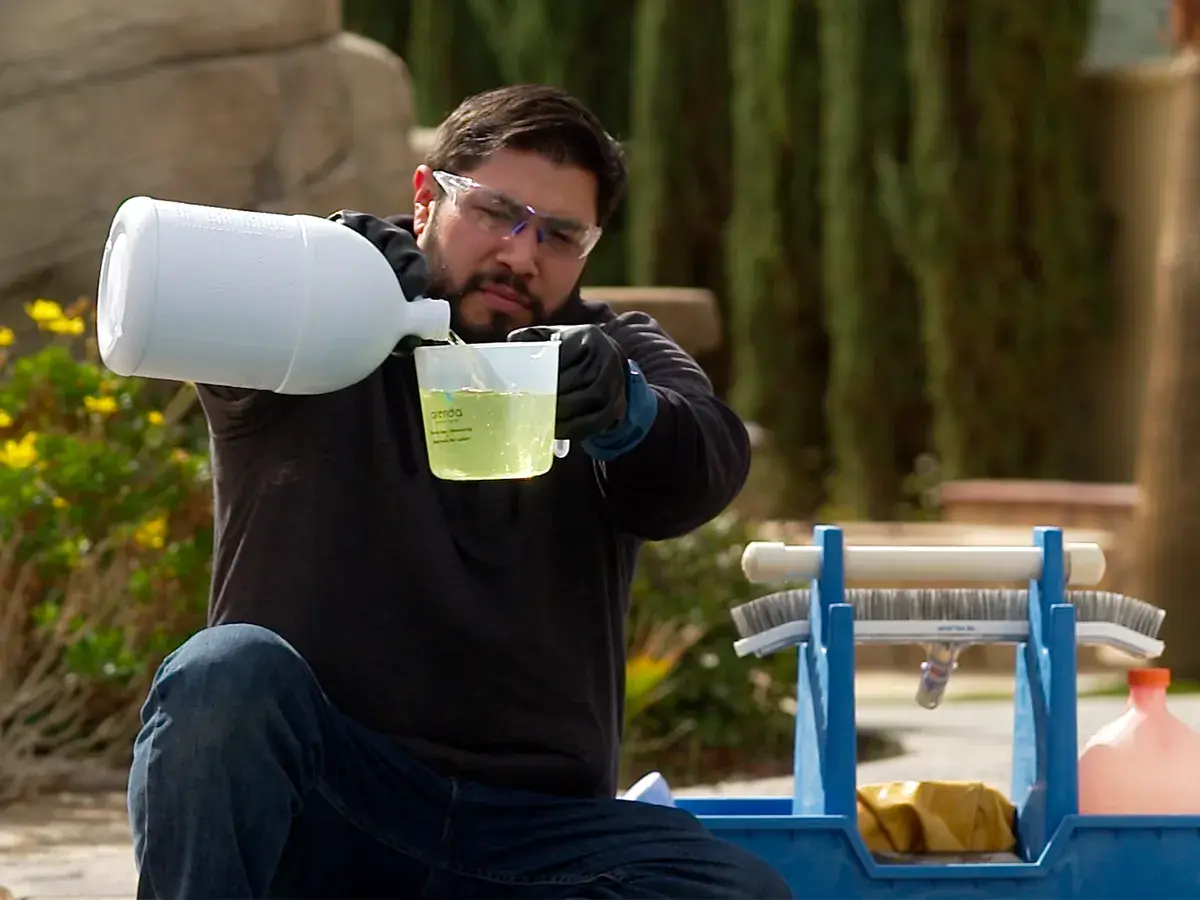
Liquid muriatic acid for pools is hydrochloric acid and contains high amounts of hydrogen. Since hydrogen is an acidic ion, it acts to lower the pH. High-purity 31.45% muriatic acid should be added to the swimming pool carefully and gradually — large doses should never be added at once or poured directly into the same area. Acid is heavier than water and will sink rapidly and settle on the bottom surface, and undiluted acid in high concentrations can cause etching of pool surfaces. The safest way to add acid to a pool is to carefully add the proper dose of acid to a bucket of water so that it is diluted. Personal safety is important when adding acid to the pool, so wear protective gloves, eye protection, and avoid breathing the fumes. HASA's own guidance dilutes it at a ratio of 10 parts water to 1-part muriatic acid. Watch Muriatic Acid | HASA for a walkthrough.
Sodium bisulfate dry acid is a dry acid salt that contributes hydrogen to the water as well. Compared to liquid muriatic acid, it's easier to handle — less hazardous to transport and doesn't produce corrosive fumes — and it's recommended for vinyl liners, fiberglass pools, and spas.

Here's how to lower pH in pool water safely:
1. Test FirstTesting the pH should be done on a weekly basis for residential backyard swimming pools. Public swimming pools should be tested at least twice daily, or as recommended by the local health department.
2. Determine the DoseUse the Pool Chemical Calculator to get a precise dose based on your pool's volume and current readings rather than guessing.
3. Dilute Before AddingThe safest way to add acid to a pool is to carefully add the proper dose of acid to a bucket of water so that it is diluted.
4. Pour it in the Right Place. Pour the diluted acid slowly around the perimeter of the pool, avoiding the areas near the light, ladders or rails, away from the skimmer and the steps. Pour acid as close to the water surface as possible to avoid splashing back, which can damage deck surfaces or lead to personal injury. The circulation system should be running, and pool acid should be added in the deepest areas of the pool. If undiluted muriatic acid is added, it should be slowly added in the deepest areas of the pool and in front of the return line to avoid concentrated acid from reaching the floor of the pool.
5. Retest Before Adding MoreIf acid is needed to lower the pH, then the water should be tested again 30 minutes to 1 hour after adding acid.
6. Add Large Doses GraduallyIf large doses of acid are required, then the acid should be diluted and added gradually in one quarter (25%) increments over time. After each incremental dose, wait 30 minutes and re-test to confirm whether more acid is needed.
Overdosing Acid
Large doses of acid should never be added at once or poured directly into the same area. If large doses of acid are required, the acid should be diluted and added gradually in one quarter (25%) increments over time, waiting 30 minutes and re-testing after each dose to confirm whether more acid is needed.
Ignoring the pH-Alkalinity Connection
The addition of soda ash to raise pH will also raise total alkalinity: 2.56 pounds of soda ash will raise the pH from 6.8 to 7.4, and that same addition raises total alkalinity by 29 ppm — an example of how closely pH and alkalinity are linked in pool water chemistry.
Improper Chemical Storage
Acid should be stored in a cool dry area with ventilation. Liquid acid should be stored at ground level separate from all other chemicals, especially chlorine. No other chemicals should be stacked on or above acid. Liquid acid should always be stored within a secondary containment receptacle to prevent spills from spreading toward incompatible chemicals and the surrounding environment. Dry acid sodium bisulfate should be kept above liquids and far away from any chlorinated products. In short, acid and pool chlorine should be kept separate to prevent any potential mixing. Direct contact of acid and chlorine in storage will lead to the formation of harmful gas, which is why understanding proper liquid chlorine handling and application goes hand in hand with safe acid storage.
The simplest way to avoid all three mistakes above is to treat water and regularly test. For a broader look at how pH fits into overall water balance, see our Pool Chemistry Guide.
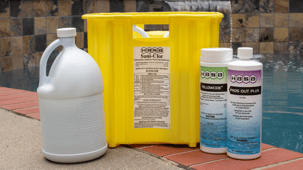
Here are some water treatment supplies to have on hand when making adjustments to pH.
What is the ideal pH for a pool? The ideal pool pH is between 7.4 and 7.6, within the broader acceptable range of 7.2 to 7.8.
How much muriatic acid do I add per gallon? As a general dosing guide, one quart of Muriatic Acid per 20,000 gallons will reduce pH. Always dilute it first, at a ratio of 10 parts water to 1-part muriatic acid, before adding it to the pool.
Can I use sodium bisulfate instead of muriatic acid? Yes. Sodium bisulfate (Dry Acid) lowers pH the same way muriatic acid does. It's easier to handle — less hazardous to transport and it doesn't produce corrosive fumes — and it's recommended for vinyl liners, fiberglass pools, and spas. However, both are considered essential water treatment for pH control.
Use our Pool Chemical Calculator to Get the Right Dose
If we were completely transparent, pool chemicals aren’t getting cheaper. As the market evolves and baseline operational costs climb, pool service...
Why Hire a Pool Service Professional? It Starts With Peace of Mind Pool chemicals are the products, chlorine sanitizers, phosphate removers, scale...
1 min read
What is a Saltwater Pool? Just what is a so-called "saltwater pool"? There is confusion over this term because there are pools in the world that use...