Five Top Contaminants in Swimming Pool Water
From Suncreen to Sweat: What's Throwing Off Your Water Chemistry As temperatures climb and pools see heavier use, that backyard or community pool...


Pool Products
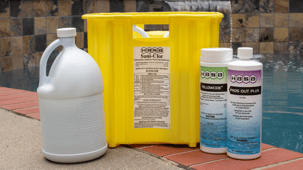
HASA has the chlorine, algaecides, and sanitizers you need to keep your pool or spa clean and clear.
Hot Tub Products
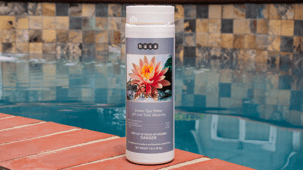
Shop our full line of Hi-Temp spa care products, including Eco-Safe Clarifiers and pH Increasers.
Ancillary Products
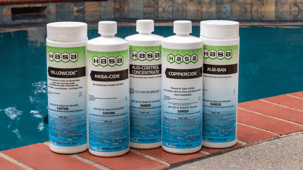
Our eco-friendly water treatments are science-backed and purposefully focused.

Mini-Bulk Program
We deliver a premium 12.5% sodium hypochlorite solution for sanitizing commercial pools and large-scale water systems.
5 min read
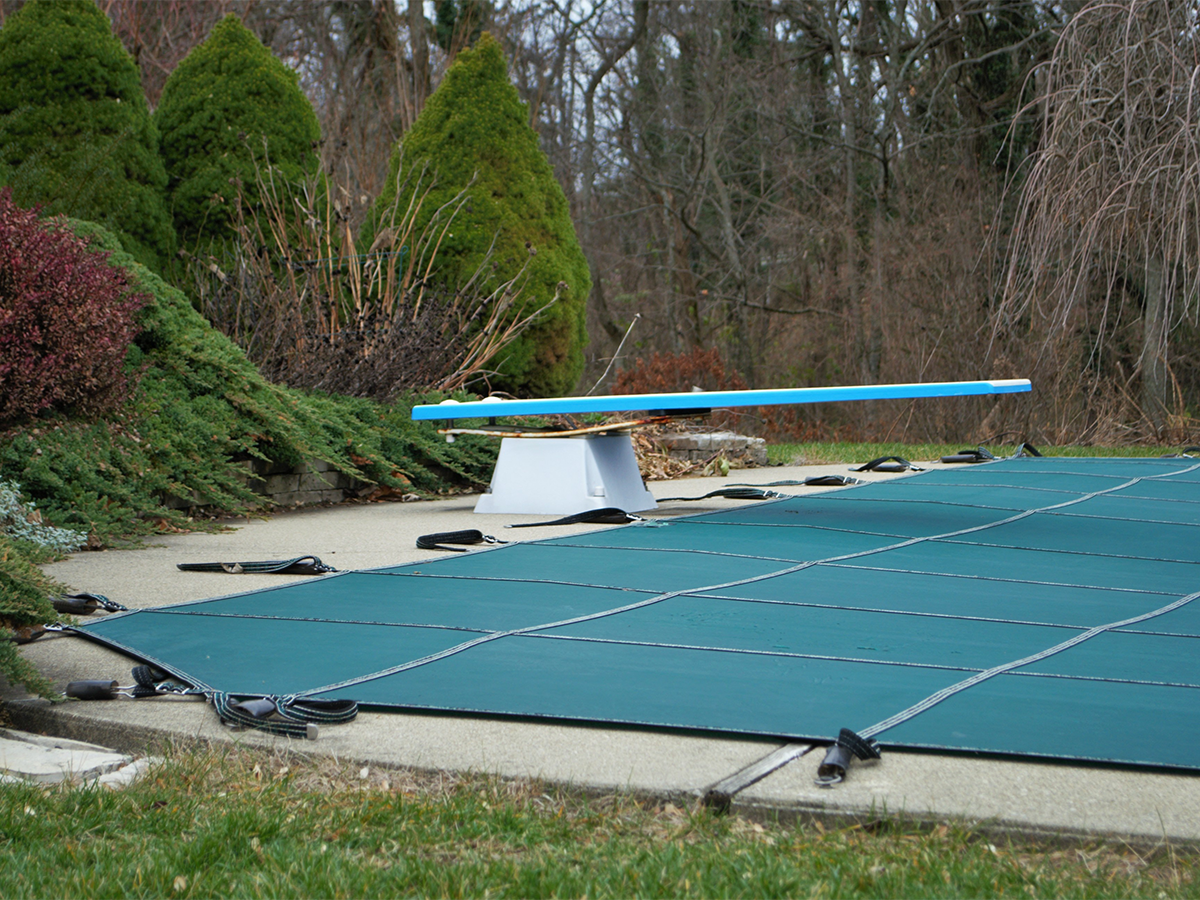
Opening a pool can only go two ways: you either have an easy opening with some minor debris to be cleared, a quick physical cleanup like cleaning the filters, removing winter plugs from the lines, and adding fresh water to top it off, followed by a streamlined process of firing up the equipment, shocking, and adding algaecide; or you can be dealing with a total swamp and plaster that feels like 80-grit sandpaper. For pool pros, service companies, and hands-on pool owners, the difference comes down to how the pool was closed towards the end of the previous season.
While the appearance, the tint, and the quality of the water can always be restored, the texture and the roughness of the cementitious finish is more permanent. This is when the immediate, hard-wired industry reflex kicks in: “Great. I got some bad calcium scale. Someone hand me the muriatic acid and a pumice stone.”
Before you go dumping gallons of acid into that pool or intend scrubbing until you run out of elbow grease, we need to talk about a massive chemical case of mistaken identity. What looks exactly like summer scale might be its bitter, vengeful chemical opposite: calcite crystals.
While both are made of calcium, they are born from completely opposite chemical origins. One is an issue of the water having too much calcium; the other is born because the water is literally starving to death.
Proactive pool care is the work of keeping water chemistry balanced, equipment maintained, essential tools on hand, and seasonal prep dialed in so pool water stays clear and safe while finishes are protected from damage. Let’s look at the counterintuitive physics of cold water and figure out how to stop this winter horror story before it starts.
To diagnose what is happening on a rough pool surface, you have to look at the Langelier Saturation Index (LSI). The LSI tells us whether water is in chemical equilibrium regarding calcium carbonate (CaCO3).
An LSI of 0.00 is perfectly balanced. When the index moves outside of the acceptable -0.30 to +0.30 range, the water forces a physical change to find its own balance.
1. Calcium Scale (Oversaturation)
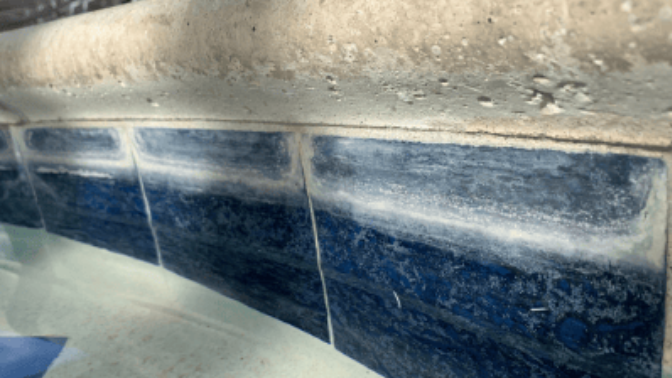
Calcium scale is a deposition problem. When the LSI climbs significantly above +0.30, the water becomes oversaturated. It cannot physically hold the minerals dissolved within it. To relieve this pressure, calcium carbonate precipitates out of the solution and deposits itself on top of the pool surfaces from the outside in. This typically creates a flat, dull, chalky film, or heavy sheet-like crust deposits along the tile line, spillways, and walls.
2. Calcium Crystals (Aggressive Extraction)
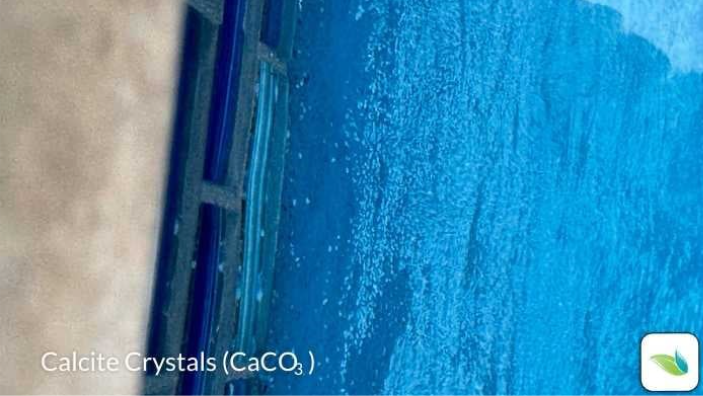
Calcium crystals are an outgrowth stagnant water problem. When the LSI drops below -0.30, the water is under-saturated and corrosive. It is hungry for calcium, and it will extract it from the easiest available source: the cementitious matrix of your pool's plaster, quartz, or pebble finish.
The hungry water actively leaches calcium hydroxide (Ca(OH)2) out from the deep pores of the plaster. As this highly alkaline compound emerges and meets the pool water, it converts into calcium carbonate right at the surface, hardening into sharp, spiky, skeletal crystal structures that grow outward from the walls.
Most pool professionals associate scaling with hot summer temperatures and high evaporation. However, calcium operates on a principle called retrograde solubility: it dissolves much better in cold water than in hot water.
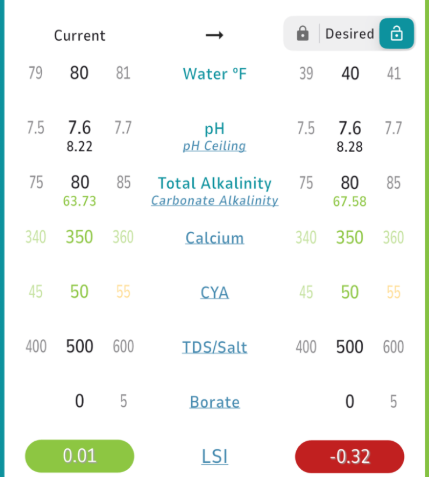 Because of this unique quirk, dropping water temperatures automatically depress the LSI. Look at how a simple seasonal temperature drop changes the chemistry profile without changing a single chemical parameter:
Summer Pool: pH 7.6, TA 80, CH 350, CYA 50, Temp 80°F = LSI: +0.01 (Balanced)
Winter Pool: pH 7.6, TA 80, CH 350, CYA 50, Temp 40°F = LSI: -0.32 (Corrosive)
By doing nothing other than letting the pool cool down for the winter, the water shifts into an aggressive state.
If left unmonitored under a winter cover for four months, this low-LSI water continuously leaches calcium hydroxide out of the plaster walls, leaving behind warning signs of unbalanced pool water like calcite crystals or severe etching.
When the pool cover is pulled back in the spring and the water warms up, the LSI swings upward again. The water, suddenly unable to hold its stolen minerals, rejects the excess calcium and drops it across the floor as a fine, white powdery layer known as "winter dust."
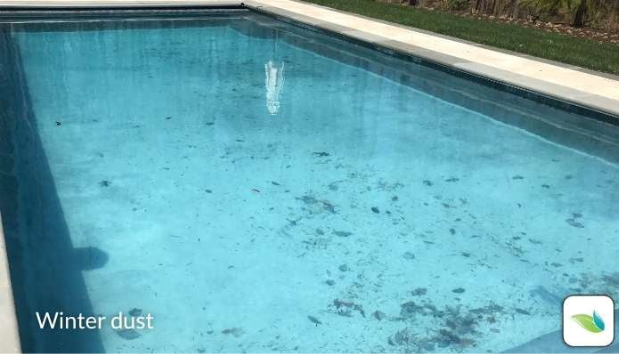
Modern pool care requires winterizing a pool based on the lowest predicted winter temperature, not the water temperature on the day the cover goes on. Managing a proactive, LSI-focused winter pool care schedule ensures you pull back that cover every spring to a flawless, smooth plaster finish and perfectly clear water.
Designing Your LSI Strategy Around Cover Type
How you prepare your water balance parameters in the late season depends entirely on what type of winter cover protects the pool, as the cover directly influences environmental dilution and water stability.
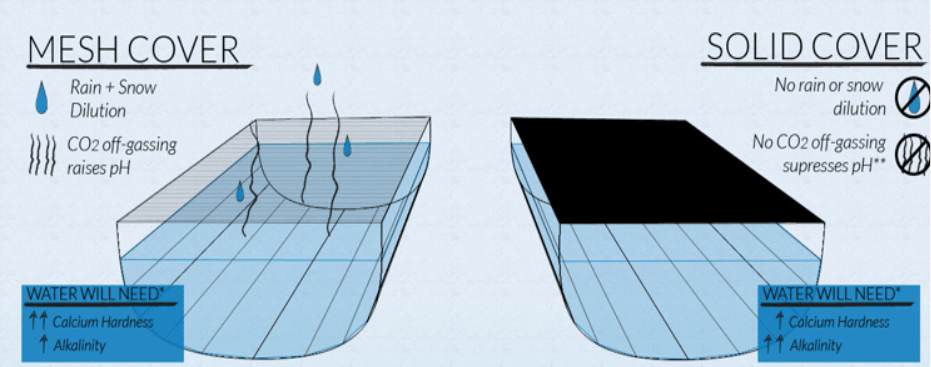
Solid Covers: Water Balance Strategy
Solid covers act like a seal, keeping rain, snow, and debris completely out. Because dilution isn’t an issue, your parameters stay stable.
Mesh Covers: Water Balance Strategy
Mesh covers let rain, snow, and fine debris wash right through, introducing acidic, zero-hardness water that continuously drags your LSI down.
Because mesh covers allow contaminants to pass through and stew for months, purging the pool with a broad-spectrum enzyme treatment a few weeks prior to closing is essential to digest organic waste and prevent greasy winter scum lines. A chelator can also be utilized for metals management, though whether it is applied at opening or closing and the specific dosage should be determined on a case-by-case basis depending on the pool's circumstances and objective.
If you have crystals at opening, the solution requires patience, not acid. You must bring the pool water into a slightly positive LSI state (+0.10 to +0.20) by allowing the water to warm up, elevating the pH, and adding calcium hardness directly to the water. Once the water is fully satisfied and slightly oversaturated, it stops attacking the walls.
Over several weeks of proper filtration and regular brushing, depending on the severity, those crystal structures might naturally soften and dissolve back into the water safely. Purging with a chelating agent at this stage is incredibly beneficial; it aids the dissolution process by safely keeping the added calcium and breaking-down crystals perfectly bound in solution, providing a clear image of when to utilize the chelator during spring opening rather than closing.
At the end of the day, water is a continuous thermodynamic equation that constantly demands equilibrium. It will achieve that balance either because you adjusted the parameters correctly in the fall, or because it forcefully extracted those minerals from your pool finish over the winter. Stop guessing, check your index, and let the science do the heavy lifting.
Not sure whether you’re looking at scale or calcite crystals? Ask Crystal, HASA’s 24/7 water chemistry assistant. Describe what you’re seeing and your test results, and get clear answers on what’s happening and what to do next.
Ready to run the numbers? Use the Orenda Calculator to check your LSI at your lowest expected winter temperature, or the HASA Pool Chemical Calculator for dosing recommendations.
Want to go deeper? Pool pros can build their LSI and winterization skills through Orenda Academy and HASA Training and Support. Pool owners can start with the HASA Pool Chemistry Guide.

From Suncreen to Sweat: What's Throwing Off Your Water Chemistry As temperatures climb and pools see heavier use, that backyard or community pool...
Why the Best Water Comes from a True Partnership

What is the "Gunk" in Your Pool? When we think of pool contamination, we usually picture leaves, dirt, bugs,pollen, oralgae.But there is an entirely...